Wanaka, August 2025
Beyond the Nervous System: A Buddhist Critique of Polyvagal Theory
Polyvagal Theory, developed by Stephen Porges, has gained wide recognition in trauma therapy, offering a compelling model of how the autonomic nervous system shapes our responses to threat, safety, and connection. It explains trauma not just as a psychological wound, but as a deeply embodied physiological state—often locked into patterns of fight, flight, freeze, or shutdown.
But in my view, a deeper question remains—one that goes beyond a purely materialistic or biological perspective: Does nervous system regulation truly address the depths of human suffering? The answer is clearly no. True freedom is not the absence of threat (and the perception of ‘safety’), but the end of clinging to what can be threatened (or feel safe) – the separate sense of self.
The Body Is Not Who We Are
Polyvagal Theory centers healing on vagal regulation—the calming function of the parasympathetic nervous system, particularly the ‘ventral vagal’ pathway associated with social engagement. This model beautifully highlights how trauma fragments our sense of safety and connection at a biological level.
Buddhism teaches something more radical: that the very sense of a fixed, embodied self is an illusion. In Buddhist psychology, clinging to identity—including identities like ‘traumatized’ or ‘dysregulated’—can reinforce suffering, rather than dissolve it.
While Polyvagal Theory encourages listening to the body, Buddhist insight urges us to see through the body’s narratives, recognizing impermanence and the constructed nature of self.
Safety vs. Liberation
In Polyvagal-informed therapy, safety is the cornerstone of healing. Therapy is all about creating environments and experiences that help clients feel ‘safe enough’ to come out of survival states.
In Buddhism, however, the ultimate aim isn’t safety—it’s liberation.
Safety is a conditioned state, always vulnerable to change. Buddhism teaches that true peace comes not from regulating the nervous system, but from letting go of attachment, craving, and aversion—even the craving for safety. In this light, constantly pursuing regulation may subtly reinforce suffering, rather than resolve it.
The Limits of Regulation
To be clear: Polyvagal Theory helps us gain an understanding about the biological side of trauma. That’s ok. We can stabilize and reconnect with our bodies after trauma. In this sense Polyvagal Theory can be integrated as a foundation for therapy practice. But from a Buddhist lens, nervous system regulation is not the destination. True healing, in Buddhism, means recognizing that no state—regulated or not—is permanent or reliable. It means going beyond the conditioned body and mind to realize freedom from suffering itself.
Integrating Both Worlds
Rather than viewing Polyvagal Theory and Buddhism as oppositional, I believe we can learn to honor both approaches: the wisdom of the body – by grounding it and creating inner safety – and the freedom of the mind – by examining the nature of self, suffering, and impermanence. Yes, trauma appears to live in the body. No, we are not the body. – ML
Wanaka, July 2025
A quote that touched my heart today:
“Wisdom is knowing I am nothing, Love is knowing I am everything, and between the two my life moves.” – Nisargadatta Maharaj
And another quote worth contemplating:
“The person who is normal in terms of being well adapted is often less healthy than the neurotic person in terms of human values. Often he is well adapted only at the expense of having given up his self in order to become more or less the person he believes he is expected to be.” – Erich Fromm, German philosopher
Wanaka, October 2023
Wabi-Sabi: The Art of Embracing Imperfection
A philosophy originated from Zen-Buddhism and deeply rooted in Japanese culture invites us to find beauty in imperfection, impermanence and incompleteness. Wabi-Sabi offers an aesthetic that encourages us to discover value in the broken, the cracks and crevices in objects and nature.
Applying this perspective onto our flaws and failures might offer a way to relax and find the beauty in the transient and the imperfection in ourselves.
Instead of obsessing with progress and perfection, we could embrace what we struggle with, accept what we resist and let go of the compulsive need to change everything for good.
Constantly bombarded by marketing slogans that lure us to participate in the next self-improvement workshop promising to take us to a “whole new level”, so that we can finally “live up to our potential” and be “the best version of ourselves” – we really do nothing else than running after that carrot in front of our nose without ever stopping and just accepting what is: a reality that will never be perfect and complete, fixed in time, forever still.
Wabi-sabi teaches us to celebrate imperfection. A chipped tea cup, wrinkles on a person’s face or weathered aspects of nature tell the manifold stories of life itself, making it all more intriguing and meaningful, while highlighting the transient aspect of every-thing.
Embracing our own imperfection means including wholeheartedly what makes us truly human and unique: our scars and flaws, our so called failures and busted dreams. Appreciating the whole package of who we are and accepting the impermanence of our existence might lead us to a deeper sense of gratitude and humbleness, encouraging us to enjoy in each moment the simplest aspects of life. – ML
Wanaka, August 2025
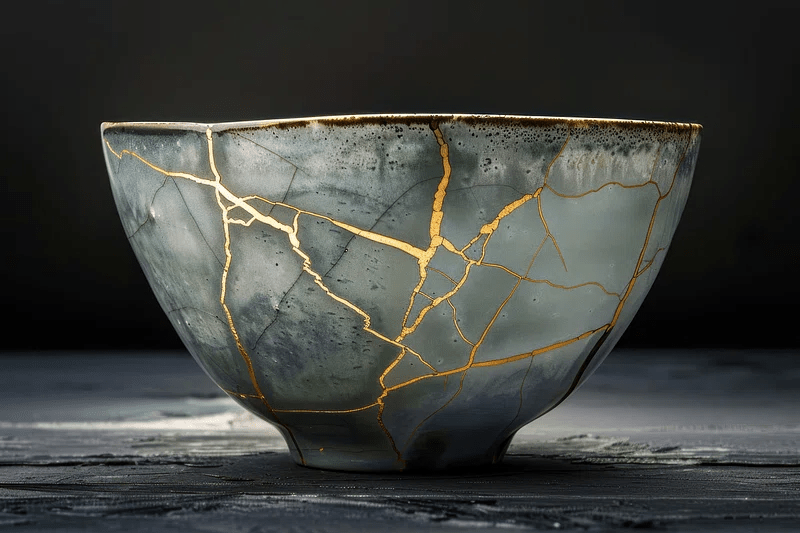
Healing Through the Cracks — The Kintsugi of Counselling
In our counselling work, we often witness something truly powerful — the quiet, courageous process of healing. Much like Kintsugi, the Japanese art of repairing broken pottery with gold, therapy doesn’t aim to erase your cracks, but to help you understand them, honor them, and grow through them. The pain, the losses, the patterns — they are not signs of weakness, but places where strength is waiting to emerge. Together, we gently explore what’s (seemingly) been broken, and over time, your story is not only restored, but reshaped into something stronger, more grounded, and deeply human. Healing isn’t about perfection — it’s about transformation. And like Kintsugi, it can be beautiful. – ML
 Wanaka Therapy